homas
Jefferson Johnson; author of the bill creating Thomas County,
and founder of Thomasville; built the first house on Pebble Hill
about 1827. Julia Ann, his daughter, married a local planter
named John W.H. Mitchell and inherited the plantation after her
parents died. The Mitchells expanded the cotton planting operations,
and in 1850, replaced the original structure with a house designed
by gifted young English architect John Wind.
Following the Civil War, Mitchell died and the strong-willed
Julia Ann maintained the plantation. After her death, Pebble
Hill was sold in 1
896
to Howard Melville Hanna, an industrialist of Cleveland, Ohio, who
was attracted by the winter climate and quail shooting. Later
Hanna gave the property to his daughter, Kate. She married
Robert Livingston Ireland and turned Pebble Hill into a showplace.
Kate and her second husband, Perry Williams Harvey, continued to
make improvements. Abram Garfield, architect and son of
President James A. Garfield, built gatehouses, a country store, and
a Jersey barn. By the 1920´s Pebble Hill stood a
glorious testimony to the sporting life.
A
n
accidental fire in the winter of 1934 consumed all but the east
wing, although the furnishings were saved. The undamaged
section was incorporated in to the present house which Garfield
completed in 1936. When Kate died, her property was divided
between her children, Robert Livingston Ireland Jr., and Elisabeth
Ireland, or Pansy as she was always known. Miss Pansy
inherited Pebble Hill.
Like her mother, Pansy was generous and hospitable. She
preserved the Plantation, and it became famous as a haven for guests
and friends. House guests included many distinguished artists
such
as
sports painters Ogden Pleissner and Richard Bishop; Gina Bachauer,
international concert pianist; presidents Dwight Eisenhower and
Jimmy Carter; ambassadors, and the Duke and Duchess of Windsor; 1930´s
writer, actress and dramatist, Cornelia Otis Skinner.
Miss Pansy was always an avid collector, and the present house
reflects her varied interests. The collections
you will see attest to her lifestyle and
curiosity.
Some bedrooms have been converted to galleries to display Mrs. Poe's
collections of 19th Century furniture,
porcelain,
silver, crystal, and glassware. The many trophies record the
success of Pebble Hill's animals in competition.
The overall impression one receives from this remarkable
Plantation is more felt than defined. Integrity, warmth,
tradition, and beauty are here in equal measure to be savored by
all.
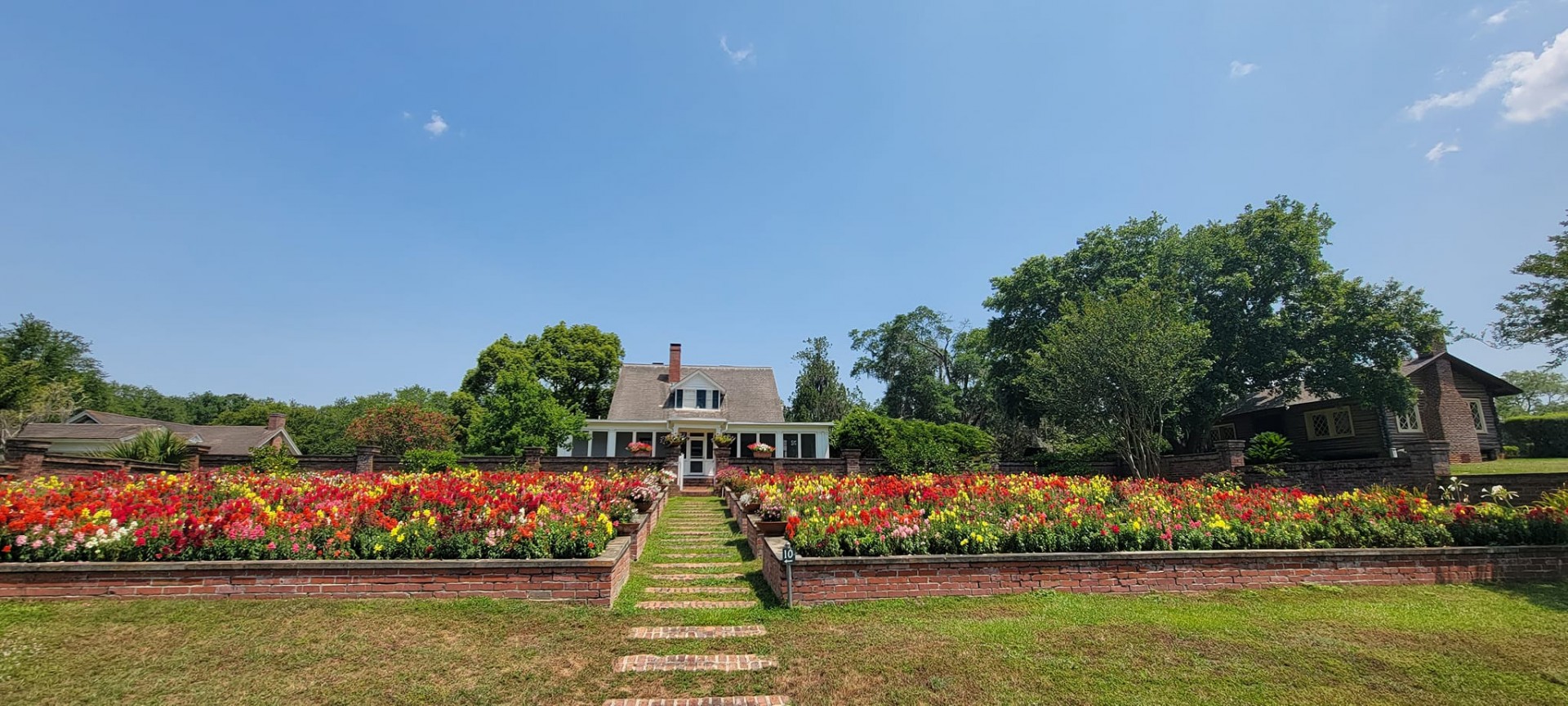
We invite you now to take a stroll
of the grounds which
compliment the house in grand style with their intriguing beauty.
The Main House tour narrative is available in English, German,
French, Japanese, and Spanish.